
Bar Chords Chart
Two moveable shapes unlock every major and minor chord on the guitar. Pick a root note and chord type, and the chart shows the E-shape barre (root on the 6th string) and the A-shape barre (root on the 5th string) at the right fret, with finger positions, the notes in the chord and a strum button so you can check your sound.
- Free to use
- No sign-up
- Runs in your browser
Barre chord finder
Barre Chord Charts
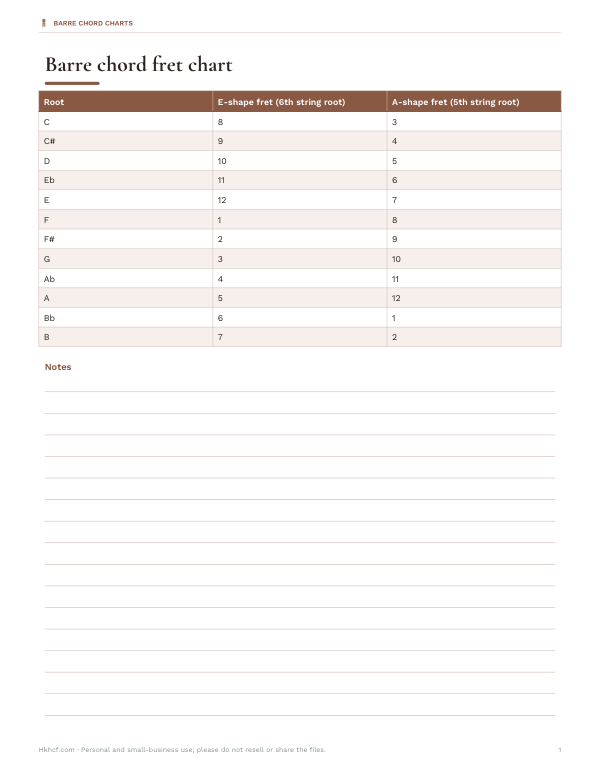
Printable barre chord charts: E-shape and A-shape fret tables for all 12 keys, a chord-type shape sheet, blank chord diagram sheets and a 4-week barre chord practice plan.
- Fret chart (PDF)
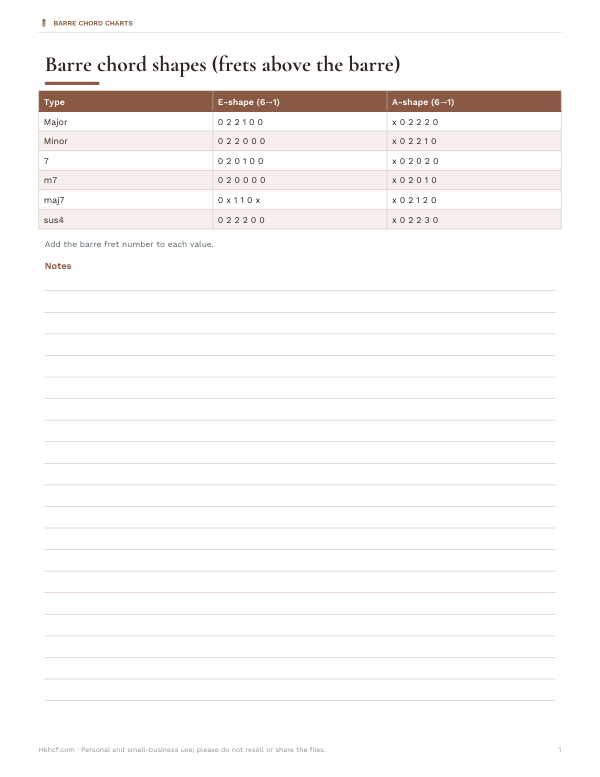
- Shape sheet (PDF)
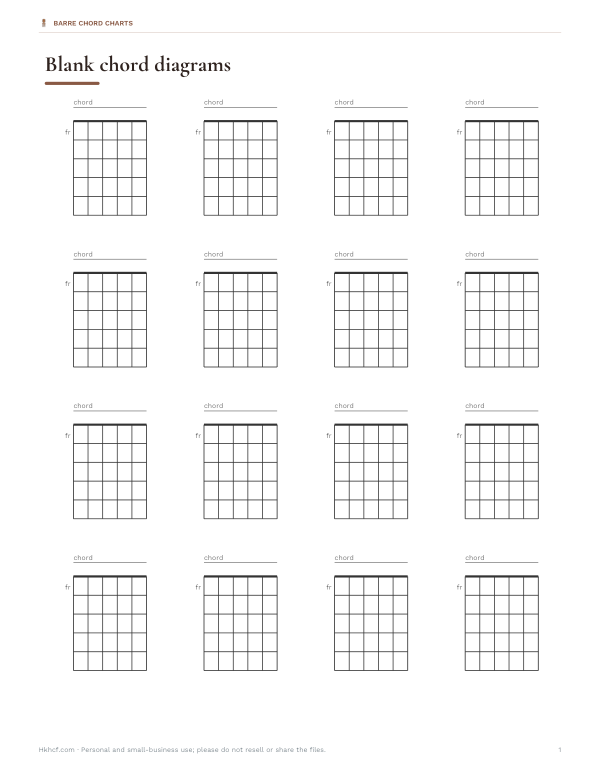
- Blank diagrams (PDF)
- Practice plan (DOCX/PDF)
Formats: PDF, XLSX, DOCX. Instant download after payment (link valid 72 hours, up to 5 downloads). AI-assisted: the templates were drafted with AI help and reviewed and laid out before publishing.
$5.00 USD, one-time 4 files · about $1.25 each
- Instant download
- 7-day refund
- Secure checkout by Stripe
7-day money-back guarantee. Full refund within 7 days of purchase, even after you download.
Free sample: Barre Chord Fret Chart (PDF, 50 KB)
Full refund within 7 days — see the refund policy and license.
Free printables
Single sheets you can print right now, no sign-up. The full pack adds every sheet in one download plus the editable files.
 Printable Barre Chord Practice Plan
What is a barre chord?
A barre (or bar) chord uses one finger — usually the index — pressed flat across several strings, acting like a movable capo, while the other fingers form an open-chord shape above it. Because the shape contains no open strings, you can slide it up and down the neck to play the same type of chord in every key. Learning just two shapes, based on the open E and open A chords, gives you all 12 major and minor chords.
E-shape barre chords (root on the 6th string)
| Chord | Fret |
|---|---|
| F / Fm | 1 |
| F# / F#m | 2 |
| G / Gm | 3 |
| Ab / Abm | 4 |
| A / Am | 5 |
| Bb / Bbm | 6 |
| B / Bm | 7 |
| C / Cm | 8 |
| C# / C#m | 9 |
| D / Dm | 10 |
| Eb / Ebm | 11 |
| E / Em | 12 |
Find the root note on the low E string, barre that fret, and add the E major or E minor shape above it. F major at the 1st fret (1 3 3 2 1 1) is the first barre chord most players learn.
A-shape barre chords (root on the 5th string)
| Chord | Fret |
|---|---|
| Bb / Bbm | 1 |
| B / Bm | 2 |
| C / Cm | 3 |
| C# / C#m | 4 |
| D / Dm | 5 |
| Eb / Ebm | 6 |
| E / Em | 7 |
| F / Fm | 8 |
| F# / F#m | 9 |
| G / Gm | 10 |
| Ab / Abm | 11 |
| A / Am | 12 |
Barre from the 5th string down and add the A shape two frets higher. B major at the 2nd fret (x 2 4 4 4 2) and C minor at the 3rd fret (x 3 5 5 4 3) are common examples. Many players fret the three middle notes of the major shape with a partial ring-finger barre.
Chord types in the finder
| Type | E-shape (from barre) | A-shape (from barre) | Sound |
|---|---|---|---|
| Major | 0 2 2 1 0 0 | x 0 2 2 2 0 | Bright, stable |
| Minor | 0 2 2 0 0 0 | x 0 2 2 1 0 | Darker, sad |
| Dominant 7 | 0 2 0 1 0 0 | x 0 2 0 2 0 | Bluesy, wants to resolve |
| Minor 7 | 0 2 0 0 0 0 | x 0 2 0 1 0 | Soft, jazzy |
| Major 7 | 0 x 1 1 0 x | x 0 2 1 2 0 | Dreamy |
| Sus4 | 0 2 2 2 0 0 | x 0 2 2 3 0 | Open, unresolved |
Numbers are frets above the barre; 0 means the barred fret and x means don’t play that string.
How to play a clean barre chord
- Place the index finger just behind the fret wire, not in the middle of the fret.
- Roll the finger slightly onto its bony side for firmer pressure.
- Keep your thumb behind the neck, roughly behind the middle finger.
- Use arm weight — pull back gently with the arm rather than squeezing with the thumb.
- Play each string one at a time to find buzzes and adjust.
- Practise changing between an open chord and a barre chord slowly, then speed up.
Worked example
For a song in the key of G using G, C, D and Em, you can play everything with barre chords: G as an E-shape at the 3rd fret, C as an A-shape at the 3rd fret, D as an A-shape at the 5th fret and Em as an A-shape minor at the 7th fret. The hand stays around the 3rd to 7th frets, and moving the same pattern up two frets plays the song in A.
Barre chords in popular progressions
| Progression (key of A) | Barre chords |
|---|---|
| A – D – E | A: E-shape 5th fret · D: A-shape 5th fret · E: A-shape 7th fret |
| A – F#m – D – E | F#m: E-shape minor 2nd fret |
| Am – F – C – G | Am: E-shape minor 5th fret · F: E-shape 1st · C: A-shape 3rd · G: E-shape 3rd |
| Bm – G – D – A | Bm: A-shape minor 2nd fret |
Because the shapes move together, changing key only means sliding the whole pattern up or down the neck.
Common problems
- Buzzing: move the barre closer to the fret and roll the finger.
- Muted 2nd or 3rd string: the crease of the index finger may sit on it — shift the finger up or down slightly.
- Hand fatigue: rest often; strength builds over weeks.
- High action: a guitar setup lowering the strings at the nut can make barre chords much easier.
- 1st-fret F is hardest: start at the 5th fret (A major) where the frets are closer, then move down.
Privacy
The finder runs in your browser. The strum sound is generated on your device.
Frequently asked questions
What is the difference between E-shape and A-shape barre chords?
E-shape chords have the root on the 6th string; A-shape chords have it on the 5th string.
Where is the F barre chord?
E-shape at the 1st fret (1 3 3 2 1 1) or A-shape at the 8th fret.
How long does it take to learn barre chords?
Many players need a few weeks of regular practice for clean barre chords.
Why do my barre chords buzz?
Usually because the barre finger is too far from the fret or not pressing evenly.
Can I play every chord with two shapes?
All major and minor chords, and many 7th and sus chords, yes.
What is a partial barre?
A barre across only some strings, such as the index finger over the top three strings.
Should beginners learn barre chords?
After a few months of open chords, yes — start with A-shape chords around the 5th fret.
Is anything uploaded?
No, it runs in your browser.